
Sustainability management
One of the main themes of Hansel’s strategy is “Sustainability is our trump card”. In practice, this has meant continuous and systematic development of sustainability work in all of our operations for years, both in the services offered to customers and in our own operations. The greatest impact in our operations is achieved through joint procurement that we tender for our public sector customers, which is why our sustainability goals are largely based on our procurement categories.
In addition to our own strategy, our operations are also guided by the priorities of the national procurement strategy and our public sector customers. These introduce targets related to, for example, carbon neutrality and the circular economy. In our own operations, we operate in accordance with agreed processes, which are described in comprehensive work instructions. Key responsibility-related work instructions include work instructions on environmental aspects, social responsibility and the grey economy, project work instructions and compliance instructions.
The category strategies for joint procurement identify sustainability risks and objectives related to the category in question, which are taken into account in procurement. For each joint procurement, a comprehensive sustainability analysis is also carried out, identifying the material issues to be taken into account through twenty ESG (Environmental, Social and Governance) themes.
Definition of double materiality
In 2025, we began a revision of our sustainability work and hired a sustainability specialist. In 2026, we intend to publish a sustainability programme that will guide our work in the future. We began preparing the programme in 2025 by conducting a double materiality assessment (DMA [in Finnish]). As a result of the materiality analysis, ten themes were confirmed as the focal points of Hansel’s sustainability work:
- climate change mitigation
- energy
- circular economy
- working conditions of value chain workers
- work-life balance of own employees
- corporate culture
- political influence
- anti-corruption
- security of supply
- savings for society
These are the themes that we have the greatest impact on as a company and through our joint procurement value chains, and the themes also involve risks and opportunities that affect our own business. We will build the priorities and objectives of our sustainability programme on the basis of this double materiality analysis and inform our stakeholders of the results of our work in our annually published sustainability report and through regular communications.
Sustainability team
The core of the sustainability efforts is the sustainability team, which consists of a nine-person matrix organisation chaired by the Director of Finance, who is responsible for sustainability in the Executive Committee, and a sustainability specialist. The duties of the sustainability team are to improve sustainability-related processes, monitor related legislation, provide training to the employees and share information about sustainability.
Hansel’s Board of Directors receives a sustainability update at each of its meetings as part of the Managing Director’s review. Following the Managing Director’s proposal, the Board of Directors has confirmed the ten focus areas resulting from Hansel’s double materiality analysis. At Hansel, sustainability is also part of the management’s remuneration model, and in addition, those working in other roles have personal sustainability-related performance targets.
Hansel’s organisation
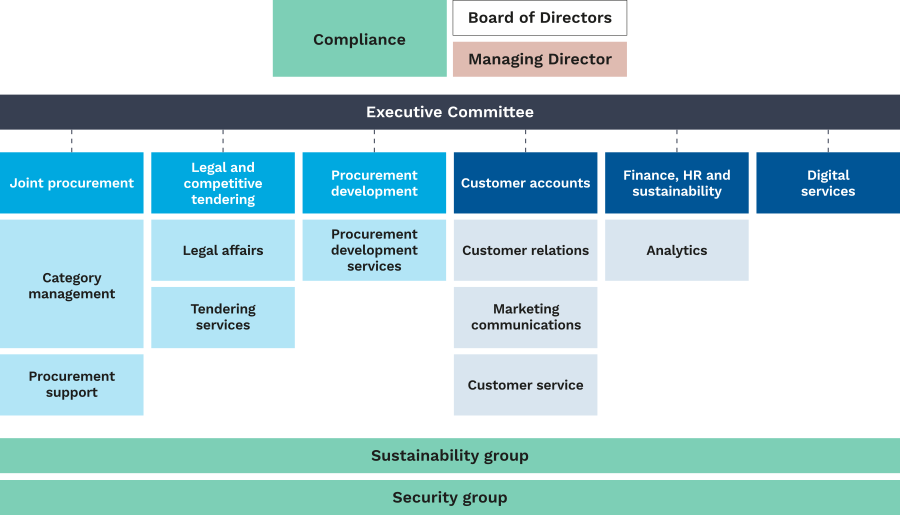
Since spring 2025, a sustainability specialist has been in charge of the practical management of sustainability work, which has had an impact on the operations of the sustainability team. The roles of the members of the sustainability team will be specified as part of the sustainability programme work. At the same time, the roles of Hansel’s various units will be assessed in relation to the goals and focus areas of sustainability work.
Sustainability in joint procurement
Hansel’s sustainability work in joint procurement is based on the UN due diligence process. In the preliminary report of each joint procurement, we carry out a risk analysis, segmentation and responsibility analysis and classify the procurement from the points of view of preparedness, data protection and information security. During the contract period, we focus on monitoring the requirements in accordance with the terms of the contract. The risk level and requirements of procurement vary, which is why the selected monitoring mechanism also varies depending on the object of the procurement.
At its lightest, this entails dialogue and possibly a self-assessment by the contractual supplier and a documentation review, while for higher-risk procurement we conduct in-house or third-party sustainability audits. If shortcomings are observed in the operations of our contractual suppliers in our monitoring, we will address them in an appropriate manner as specified in the contract. The most important thing is to try to reduce risks in advance through smooth cooperation and find solutions to any problems together with the contractual suppliers.
Sustainability labels by category
| Category | Joint procurement 2025, EUR thousand | Ecolabel, EUR thousand | Social responsibility label, EUR thousand | Economic responsibility label, EUR thousand | Ecolabel, % | Social responsibility label, % | Economic responsibility label, % |
| Software | 225,870 | 4,312 | 0 | 225,870 | 2 | 0 | 100 |
| Specialist services | 208,826 | 49,616 | 3,725 | 208,264 | 24 | 2 | 100 |
| Energy | 183,510 | 153,498 | 4,890 | 183,509 | 84 | 3 | 100 |
| Financial services | 183,250 | 146,838 | 0 | 183,250 | 80 | 0 | 100 |
| IT hardware | 151,735 | 149,278 | 149,767 | 151,659 | 98 | 99 | 100 |
| HR and healthcare services | 140,939 | 0 | 10,570 | 140,939 | 0 | 7 | 100 |
| Food and restaurant services | 124,920 | 124,920 | 123,557 | 124,920 | 100 | 99 | 100 |
| Vehicle and logistics services | 118,115 | 103,759 | 53,443 | 118,115 | 88 | 45 | 100 |
| Furniture and office services | 89,245 | 84,079 | 73,252 | 88,860 | 94 | 82 | 100 |
| Travel and meeting services | 84,993 | 52,262 | 83,474 | 84,993 | 61 | 98 | 100 |
| Data communications | 77,769 | 2,362 | 31,300 | 77,769 | 3 | 40 | 100 |
| Cleaning services and supplies | 71,253 | 71,261 | 60,270 | 71,253 | 100 | 85 | 100 |
| Data centre services and hardware | 49,482 | 7,709 | 0 | 49,482 | 16 | 0 | 100 |
| Security technology and related services | 42,596 | 35,846 | 1,390 | 42,573 | 84 | 3 | 100 |
| Social welfare and healthcare services | 26,353 | 26,353 | 26,353 | 26,353 | 100 | 100 | 100 |
| Healthcare and laboratory products | 9,454 | 9,454 | 9,454 | 9,454 | 100 | 100 | 100 |
| Total | 1,788,309 | 1,021,547 | 631,446 | 1,787,265 | 57 | 35 | 100 |
Emissions from Hansel’s own operations
The emissions resulting from Hansel’s own activities have been calculated in accordance with the GHG Protocol and with similar boundaries since 2020. Scope 1 and Scope 2 emissions were zero at Hansel. Emissions decreased by 13 per cent year-on-year. In 2024, emissions were increased by the replacement of computers and displays, which was reflected as a reduction in emissions in the calculations for 2025. In other respects, emissions rose due to an increase in purchased services. A slight reduction occurred in company cars, IT services, and business travel. In practice, there is no clear trend in Hansel’s emissions development, as practical emission reduction measures have already been taken.
| 2025 | 2024 | 2023 | 2022 | 2021 | Change, % (compared to 2024) | |
| Total emissions (excl. Hilma), (Scopes 1–3), tCO2eq* | 729 (76) | 840 (87) | 661 (74) | 480 (55) | 535 (62) | –13% |
| Total emissions (incl. Hilma), (Scopes 1–3), tCO2eq* | 875 (91) | 982 (102) | 865 (97) | 591 (68) | 651 (76) | –11% |
| Scope 1, tCO2eq | 0 | 0 | 0 | 0 | 0 | 0% |
| Scope 2, tCO2eq | 0 | 0 | 0 | 0 | 65 | 0% |
| Scope 3 (excl. accounting/Envimat data), tCO2eq | 51 | 200 | 70 | 43 | 37 | –75% |
| Scope 3 (excl. Hilma), tCO2eq | 729 | 840 | 661 | 480 | 471 | –13% |
| Scope 3 (incl. Hilma), tCO2eq | 875 | 982 | 865 | 591 | 587 | –11% |
| Emissions per employee, tCO2eq per person (labour units; incl. accounting/Envimat data) | 5.3 | 6.4 | 5.4 | 4.0 | 4.6 | –17% |
| Emissions per employee, tCO2eq per person (labour units; excl. accounting/Envimat data) | 0.4 | 1.5 | 0.6 | 0.4 | 0.9 | –73% |
| *The figure in brackets indicates how many average Finns’ annual emissions to which the total emissions correspond. | ||||||
Hansel’s sustainability reporting
The results of Hansel’s sustainability efforts are presented in the Sustainability Report, which is published annually in Finnish, Swedish and English, integrated into the Annual Report. Regarding sustainability, the report presents key information for 2025 and information about interesting events and sustainability achievements. The Sustainability Report for 2024 was published on 25 March 2025. The structure of the report is based on the international GRI Standards. The standards used are from 2021.
The report includes a table presenting the content of the report by materiality theme, the GRI Standards used, as well as where the information can be found in the report. If a piece of information is unavailable, it is mentioned in the table alongside the grounds for not including it. Some information is provided in the financial statements.
The report has been created by Hansel’s communications unit in cooperation with advertising agency SST. The entire sustainability team participates in the report’s preparation, and it is approved by the Executive Committee. The Sustainability Report is also submitted to the Board of Directors for information.
Photographss: Akindof, Lasse Lecklin, Tina Lindroos, Mika Pakarinen, Sara Nordlund, Mika Nuorva, Sami Peltoniemi, Jetro Stavén and Hansel’s communications unit. The photographs in the Annual Report feature Hansel’s specialists and customers interviewed for the articles.
For additional information, please contact:
Johanna Rasilainen
Communications Manager
johanna.rasilainen@hansel.fi
tel. +358 29 444 4289
Hansel’s Sustainability Report is available at vuosikertomus2025.hansel.fi (in Swedish at arsberattelse2025.hansel.fi and in English at annualreport2025.hansel.fi). The Sustainability Report is published exclusively online for the twelfth time, and it has been verified by KPMG Oy Ab, Authorised Public Accountants.
Read next: Double materiality analysis
You may also be interested in

Double materiality analysis
Materiality analysis has been part of Hansel’s sustainability work and reporting for a long time.

Sustainability audit on the joint procurement of AV equipment and services
Hansel conducts an annual sustainability audit of one joint procurement.

Preventing labour exploitation in cleaning service procurement
Hansel participated in a joint development and peer learning project carried out in 2025.
